
Affiliate-Links: Bei Links mit * erhalten wir eine Provision. Für dich ändert sich der Preis nicht. Details in der Datenschutzerklärung.
KI-Hinweis (KI-Assistenz): Dieser Beitrag wurde von DadChecks Editorial KI-gestützt erstellt und von den automatisierten Prüfagenten der Redaktion geprüft. Keine Person hat den Beitrag selbst geschrieben oder selbst getestet. Es handelt sich um eine Recherche, nicht um einen Praxistest: Es gab keine eigene Testhardware, keine eigenen Messungen und keine eigene Kaufentscheidung.
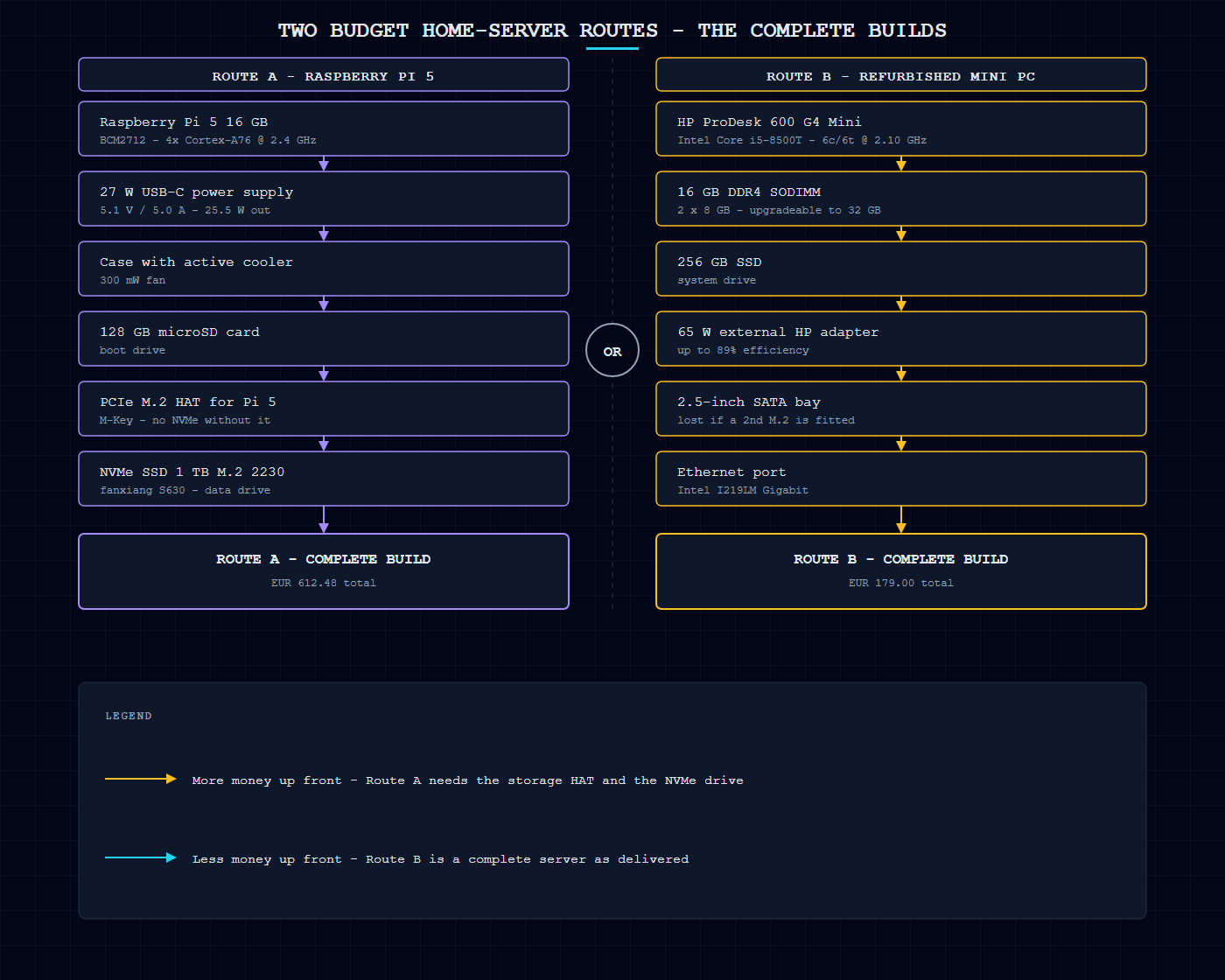
Two ways to spend money on a budget home server. A Raspberry Pi 5 16 GB is sold as a bundle with a 27 W supply, a case with fan and a boot card. A refurbished Intel mini PC is i5-8500T, 16 GB of RAM and an NVMe drive — roughly a third as much.
A bare Pi 5 board is no home server, so this prices two complete, working configurations and separates purchase price from the electricity bill.
Part 1 of three on the Budget Mini-PC Home Lab. Part 2 covers installing Proxmox VE on a used mini PC, Part 3 backing up and restoring that Proxmox lab. The host choice decides what the other two can talk about. After the hardware, the recovery plan covers what a lab needs once the host is running.
What this article covers
Objective: decide between a Raspberry Pi 5 and a refurbished Intel mini PC for a home lab, on cost and on what each machine is actually good at.
Requirements: no tools for the Pi route; the mini-PC route needs a USB stick and patience with a BIOS. No prior server experience required.
Applicable versions: the Raspberry Pi 5 16 GB (product brief RP-008348-DS-8, November 2026). The mini PC is the HP ProDesk 600 G4 Desktop Mini with the Intel Core i5-8500T, per Intel ARK and HP QuickSpecs.
Prerequisites: for the electricity figures, a German household tariff — 35.7 cent per kWh, the German average for November 2026 published by Verivox.
The two configurations side by side
| Dimension | Raspberry Pi 5 (16 GB) | HP ProDesk 600 G4 Mini / i5-8500T |
|---|---|---|
| CPU | Broadcom BCM2712, 4 × Cortex-A76 at 2.4 GHz, 2 MB L3 | Intel Core i5-8500T, 6 cores, 2.10 GHz base, 3.50 GHz turbo, 9 MB cache |
| Memory | LPDDR4X-4267, up to 16 GB, soldered | DDR4-2666 SODIMM, max 32 GB, 2 slots, upgradeable |
| Storage | microSD, 1 × PCIe 2.0 x1 via M.2 HAT, no SATA | 1 × M.2 2280 NVMe, 1 × 2.5-inch SATA bay; the bay is lost if a second M.2 is fitted |
| Network | Gigabit Ethernet, PoE+ via HAT, 802.11ac, Bluetooth 5.0 | I219LM Gigabit Ethernet; optional 802.11ac WLAN, usually absent on a used unit |
| Typical draw | 4–5 W board minimum (RP-010139, “An overview of power consumption”) plus 300 mW case fan | 12–16 W idle at 120 V wall (ServeTheHome, 2020-11-22); HP’s own energy efficiency data listed is for a typically configured PC featuring a hard disk drive |
| Rated supply | 27 W USB-C, 5.1 V / 5.0 A, 25.5 W out | 65 W external HP adapter, up to 89 % efficiency |
| Expandability | Fixed: RAM soldered, one PCIe lane, no native SATA controller and no SATA data connector | DDR4-2666 (Transfer rates up to 2666 MT/s), 32 GB, 2 SODIMM; M.2 NVMe, SATA bay |
| Noise | Case fan, quiet at idle, audible under load | HP declares Sound Pressure (LpAm, decibels) = 19 idle and 20 for fixed-disk random writes |
| Size | 85 × 56 mm | 17.7 × 17.5 × 3.4 cm, about 1 litre |
| Virtualization | None. An ARM single board computer, not a virtualisation host. | VT-x, VT-d, EPT: Yes — Proxmox VE and any x86 hypervisor can use them |
| Software | ARM64 Linux only; images need an ARM64 build | x86-64: every image, package and appliance, including the Part 2 installer |
| Operating range | 0 °C to 70 °C | 10 °C to 35 °C ambient, 10–90 % humidity |
Intel ARK on virtualization support: “Intel® Virtualisierungstechnik (VT-x)”
The i5-8500T has VT-x, VT-d and Extended Page Tables — what a hypervisor needs. The Pi 5 exposes none of it, so Proxmox on a Pi 5 is a different product, not a slower one. The Pi’s RAM is soldered.
Option A: the Raspberry Pi 5 route, priced completely
Raspberry Pi 27 W USB-C Power Supply official spec: “output 5.1 V / 5.0 A; output power 25.5 W“
A Pi 5 build is not one purchase: a board, a supply that can deliver what the board asks for, a cooler, a way to boot and a way to store data. The board input is 5 V / 5 A via USB-C, reachable only from a 5.1 V Power Delivery source over an e-marked cable. RP-010139 is blunter: “For most applications, Raspberry Pi recommends: • Using heatsinks for moderate workloads • Using a fan for heavy workloads or when using a Raspberry Pi 5 • Using a reliable power supply”.
Raspberry Pi 5 SBC documentation: “the Raspberry Pi 5 board has NO native SATA controller”
The table below is the complete Pi route. The 16 GB kit is a bundle containing the 27 W supply, the case with its fan and a 128 GB microSD card, so those are not charged twice.
| Item | Price | Note |
|---|---|---|
| Raspberry Pi 5 16 GB starter kit (board, 27 W PSU, case with fan, 128 GB microSD)* (one of these two — see the totals below) | EUR 409.99 as of 2026-11-16 | Amazon.de, db-tronic 16 GB / 128 GB edition. A KIT, not a bare board: it contains the 27 W supply, the case with fan and a 128 GB microSD card. The bare 16 GB board had no priced listing on the capture date. Kit contents: board, 27 W supply, case with fan, 128 GB microSD card, card reader, heatsink, HDMI cable. |
| Raspberry Pi PCIe M.2 HAT for Pi 5 (M-Key) | EUR 12.50 as of 2026-11-16 | BerryBase. Not in the kit: without it the Pi 5 cannot reach an NVMe drive over PCIe. |
| NVMe SSD 1 TB, M.2 2230 (fanxiang S630)* | EUR 189.99 as of 2026-11-16 | Amazon.de. A data drive: the Pi 5 boots from the microSD card. |
| HP ProDesk 600 G4 Mini / i5-8500T, 16 GB RAM, 256 GB SSD (one of these two — see the totals below) | EUR 179.00 as of 2026-11-16 | Kleinanzeigen private listing. A used machine, and the price of one. |
| RAM upgrade to 16 GB (DDR4 SODIMM 2 x 8 GB) | EUR 0.00 as of 2026-11-16 | The 16 GB variant already carries 16 GB; a machine bought as 8 GB needs this line. Shown at 0.00 EUR because the chosen listing already includes the memory. |
| Raspberry Pi 5 route total | EUR 612.48 as of 2026-11-16 | The kit, the M.2 adapter and the NVMe drive. The supply, case and boot card are inside the kit. |
| Refurbished mini PC route total | EUR 179.00 as of 2026-11-16 | The mini PC arrives with CPU, 16 GB RAM, a 256 GB SSD, the chassis and the 65 W HP supply. |
| Price date | 2026-11-16 | Prices checked on 2026-11-16. Source: Amazon.de, Geizhals, BerryBase, Kleinanzeigen (EUR as displayed on the day) |
First, the bare 16 GB board had no priced listing on 2026-11-16 — every live listing was a bundle. BerryBase showed it at 415.90 EUR but marked it “not currently deliverable”; Geizhals’ best offer was 409.94 EUR plus 8.90 EUR shipping. The kit at 409.99 EUR was cheaper and obtainable.
Raspberry Pi 5 microSD card slot: “microSD card slot with support for high-speed SDR104 mode”
Second, the NVMe drive is a data drive, not a boot drive — the Pi boots from the kit’s microSD card, so a server keeping its configuration there has one failure point.
Why the M.2 HAT is not optional
The Pi 5 is the first Raspberry Pi with a PCI Express interface: “Platform exposes a single-lane PCI Express 2.0 interface for the first time on Raspberry Pi”. It “requires a separate M.2 HAT or other adapter”, and the HAT+ runs single-lane PCIe 2.0 at up to 500 MB/s.
Raspberry Pi 27 W supply output rating: “output voltage 5.1 V, output current 5.0 A”
One limitation belongs in any build plan: “The Raspberry Pi 5 isn’t certified for Gen 3.0 speeds. PCIe Gen 3.0 connections might be unstable.”
Option B: the refurbished mini PC route, priced completely
The reference machine is an HP ProDesk 600 G4 Desktop Mini with the Intel Core i5-8500T — a business desktop from around 2018, and on the German refurbishment market the cheapest credible way to get x86 virtualization into a home lab. Six German and EU sellers on 2026-11-16 ran from 179.00 EUR to 269.00 EUR. The same chassis is the subject of Choosing a Budget Batocera PC for Intel 8th-Gen Mini PCs.
| Item | Price | Note |
|---|---|---|
| HP ProDesk 600 G4 Mini / i5-8500T, 16 GB, 256 GB SSD | EUR 179.00 as of 2026-11-16 | Kleinanzeigen private listing. A used machine, and the price of one. |
| Host total | EUR 179.00 as of 2026-11-16 | The refurbished mini PC as it arrives, with its own power supply. Prices checked on 2026-11-16. Source: Kleinanzeigen private listing (EUR as displayed on the day) |
The mini PC arrives complete: CPU, memory, a 256 GB SSD, chassis and the 65 W HP supply. That price charges for parts it already has.
What you give up with the mini PC
The storage layout has one trap, and HP documents it clearly: “2.5” SATA storage drive cannot be installed if 2nd M.2 is configured.” The two M.2 slots and the 2.5-inch bay compete.
Intel ARK on the Core i5-8500T graphics: “Integrated graphics: Intel UHD Graphics 630, base 350 MHz”
The WLAN is usually absent too. A refurbished office machine normally has none. Plan for the cable — Build a Smart-Home-Ready Network.
And the machine is used. “These are used units so it may vary a bit” is how the independent reviewer put it after measuring the idle draw. Check the drive health, and accept that the warranty is gone.
What each build costs to run
Purchase price is only the first number. A home server runs 24 hours a day, so electricity is the running cost — computed by the same build-cost calculator that produced the tables above:
kWh per year = (watts / 1000) × hours per day × 365
cost per year = kWh per year × EUR per kWh
Two rules separate a useful figure from a wrong one. The watts figure is the typical measured draw, never the maximum rated power. The tariff is dated: 35.7 cent per kWh, the German average for November 2026.
| Host | Typical draw | Source of the draw figure | kWh per year | Cost per year | Cost per month |
|---|---|---|---|---|---|
| Raspberry Pi 5 with the Active Cooler | 5.3 W | White paper RP-010139 (minimum 4–5 W) plus the case fan at 300 mW | 46.4 kWh | 16.57 EUR | 1.38 EUR |
| HP ProDesk 600 G4 Mini / i5-8500T | 14 W | ServeTheHome measured 12–16 W idle at 120 V wall on a used unit; 14 W is the midpoint | 122.6 kWh | 43.78 EUR | 3.65 EUR |
Raspberry Pi white paper RP-010139: “An overview of power consumption”
The two draw figures come from different places. The Pi’s 4–5 W is a board minimum from the manufacturer’s white paper, and 5.3 W adds the case fan. The mini PC’s 14 W is the midpoint of a wall measurement on a used unit at 120 V, taken in 2020. HP’s energy efficiency data listed is for a typically configured PC featuring a hard disk drive. The 27.21 EUR per year gap is the x86 running-cost premium.
As of 2026-11-16 the Pi route costs 612.48 EUR to buy and 16.57 EUR a year to run; the mini PC route costs 179.00 EUR to buy and 43.78 EUR a year to run. HP’s energy efficiency data listed is for a typically configured PC featuring a hard disk drive. The mini PC pays for its electricity disadvantage several times over in its first year.
The decision matrix
| What you want to run | Pi 5 | Refurbished mini PC | Why |
|---|---|---|---|
| Docker containers (ARM64 images exist) | Good fit | Good fit | Fine, if the image has an ARM64 build. |
| Docker containers (any x86 image) | Poor fit | Good fit | Most public images are amd64. |
| Proxmox VE, KVM or LXC | Not possible | Good fit | No virtualization assist on the Pi; the i5-8500T has VT-x and VT-d. |
| Home Assistant | Good fit | Good fit | The Pi’s low draw wins on electricity. |
| Media server with hardware transcoding | Poor fit | Good fit | UHD Graphics 630 has QuickSync; the Pi’s VideoCore VII has no transcode path. |
| Heavy CPU work (transcoding, builds) | Poor fit | Good fit | 6 cores at 3.50 GHz turbo against 4 at 2.4 GHz; the Pi throttles without a fan. |
| Running Windows alongside Linux | Not possible | Good fit | x86 guests need x86 hardware and nested virtualization. |
| Lowest electricity bill | Good fit | Acceptable | 16.57 EUR against 43.78 EUR per year at the November 2026 German average; HP’s own energy efficiency data listed is for a typically configured PC featuring a hard disk drive |
| Smallest footprint | Good fit | Acceptable | The dimensions of a Raspberry Pi 5 are approximately 85 mm × 56 mm, against about one litre. |
| Silent in a living room | Good fit | Acceptable | HP declares Sound Pressure (LpAm, decibels) = 19 idle. |
| Upgradeable years from now | Poor fit | Good fit | RAM is soldered on Raspberry Pi 5; the mini PC takes 32 GB, 2 SODIMM. |
| Zero used hardware risk | Good fit | Acceptable | The Pi is new; a refurbished machine has no warranty. |
The recommendation
If you want one machine to do everything — Proxmox, virtual machines, containers, media — buy the refurbished mini PC. HP’s energy efficiency data listed is for a typically configured PC featuring a hard disk drive. 179.00 EUR against the Pi route’s 612.48 EUR is a difference of 433.48 EUR; at the 27.21 EUR per year running-cost premium it takes more than fifteen years to erase. Hardware virtualization is what makes the Part 2 path possible at all.
If you want a quiet, low-power appliance for a handful of services and you are comfortable staying in the ARM64 world, buy the Pi 5. You give up virtualization, soldered memory and any upgrade path, and pay more for less CPU.
Raspberry Pi 5 mechanical drawing: “The dimensions of a Raspberry Pi 5 are approximately 85 mm”
Two things would change this recommendation: you already own a Pi 5, or you have a spare machine with VT-x.
Limitations
- No machine was tested by us. Every figure is a manufacturer specification or an identified independent measurement.
- Prices are dated observations (2026-11-16) and move.
- The Pi route is priced as a kit. The bare 16 GB board had no obtainable priced listing that day.
- The electricity figures use one tariff. 35.7 cent per kWh is the German average for November 2026; your own tariff moves both columns, the ratio does not. HP’s energy efficiency data listed is for a typically configured PC featuring a hard disk drive.
- One refurbished market, one day. The 179.00–269.00 EUR band was six listings.
Raspberry Pi power supply recommendation: “For Raspberry Pi 5, we recommend the 27 W USB-C Power Supply.”
Troubleshooting: two things that will surprise you
Raspberry Pi white paper RP-010139 on cooling: “Using a fan for heavy workloads or when using a Raspberry Pi 5“
Symptom: the Pi 5 USB-C port is not charging. Not all USB-C supplies negotiate the 5 V / 5 A the board asks for, and 5 A over USB-C needs a 5.1 V Power Delivery source with an e-marked cable. The documentation states it plainly: “All Raspberry Pi models require a 5.1 V supply; Raspberry Pi 4, Pi 400, Pi 500 and Raspberry Pi 5 use a USB-C connector”, and “For Raspberry Pi 5, we recommend the 27 W USB-C Power Supply.” A 5 V / 3 A supply restricts downstream USB peripherals to 600 mA instead of 1.6 A.
Symptom: the mini PC has no display after you add a second M.2 drive. Not a fault. HP’s QuickSpecs carries the trade-off as a note, and the display output on a Desktop Mini is configurable: DisplayPort 1.2, HDMI 2.0, VGA or USB Type-C. Check which port you are plugged into before you go looking for a broken GPU.
References
- Raspberry Pi Ltd, Raspberry Pi 5 product brief RP-008348-DS-8 (November 2026): product brief PDF
- Raspberry Pi Ltd, “Use-case-specific thermal performance of Raspberry Pi SBCs”, white paper RP-010139: white paper PDF
- Raspberry Pi Ltd, SBC and power-supply documentation: SBC documentation
- Raspberry Pi Ltd, M.2 HAT+ and 27 W USB-C Power Supply product pages: M.2 HAT+, 27 W supply
- Intel, Intel Core i5-8500T specifications (Intel ARK): ARK specifications
- HP, HP ProDesk 600 G4 Desktop Mini QuickSpecs (c06057132): QuickSpecs
- HP, HP ProDesk 600 G4 Desktop Mini product specifications: product specifications
- ServeTheHome, “HP ProDesk 600 G4 Mini Review and Guide”, Patrick Kennedy, 22 November 2020: power measurements
- Verivox, “Strompreisentwicklung”, German average electricity price, November 2026: tariff source